













 图源:https://unsplash.com/photos/34_rguvk_5Y
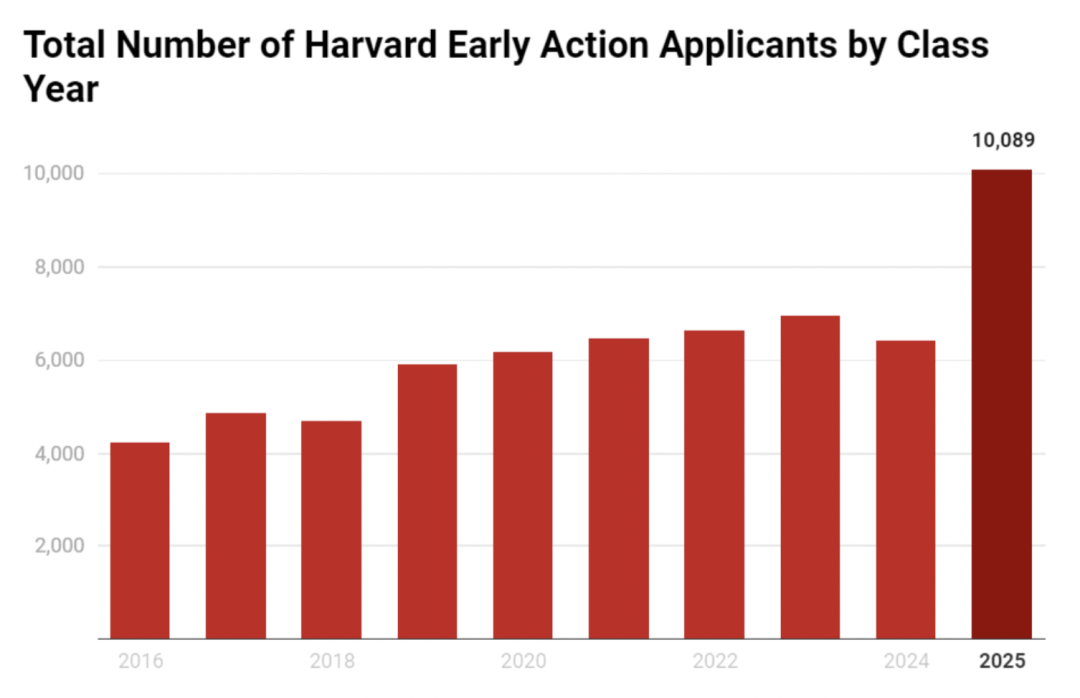
下图为哈佛大学过去十年历届早期申请人数对比
 图源:https://www.thecrimson.com/article/2020/12/18/harvard-early-admits-2025/
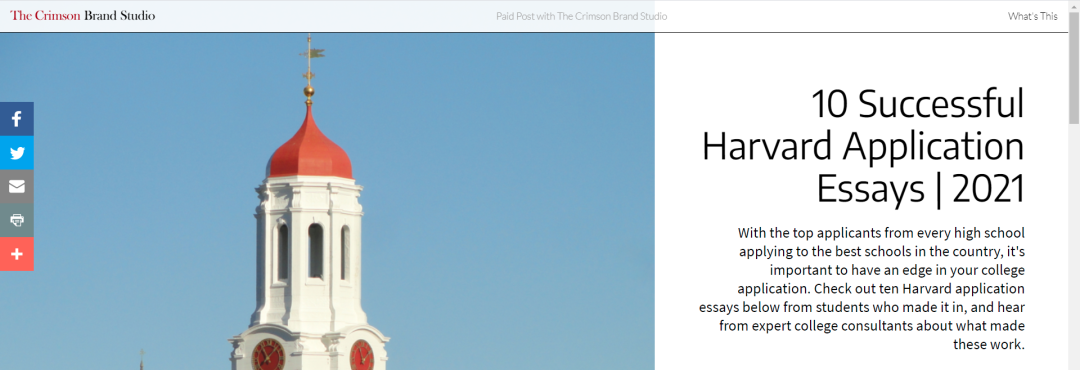
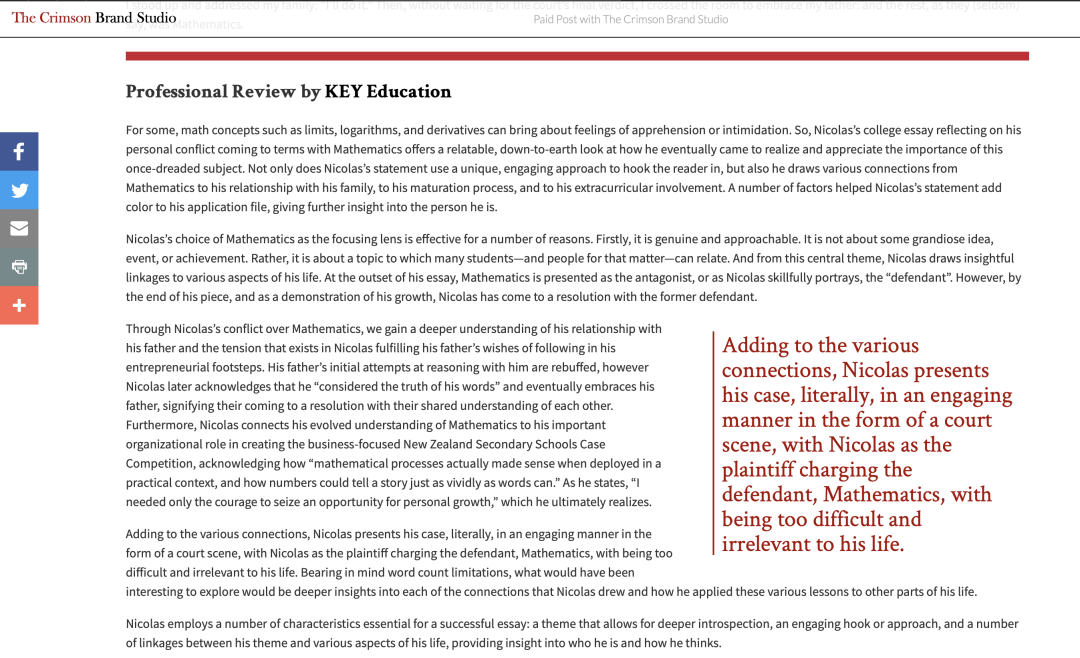
今年,KEY还收到了The Harvard Crimson – 哈佛大学官方校报的特别邀请,点评哈佛大学2021 TOP 10 录取文书中来自华裔申请人的一篇。
 图源:https://www.thecrimson.com/topic/sponsored-successful-harvard-essays-2021/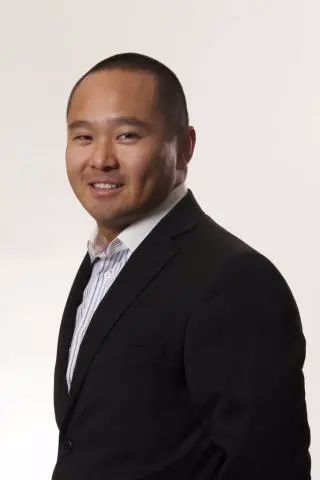
Bryan Ide
KEY Education教育总监&合伙创办人
– 毕业于加拿大温哥华圣乔治高中(St. George’s School)
– 康奈尔大学文学学士学位
– 哥伦比亚大学硕士研究生学位
– 曾任圣乔治高中招生官和奖学金面试官
– 曾任康奈尔大学位于加拿大BC省的招生主席
– 曾任UBC Sauder商学院( Sauder School of Business) 部门主管及校友联络网负责人
Successful Harvard Essay – Nicolas
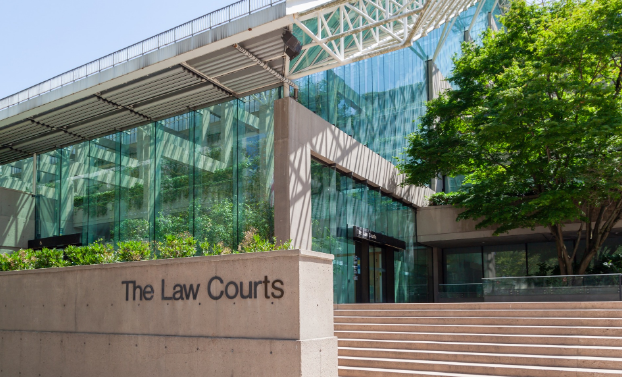
When I failed math in my sophomore year of high school, a bitter dispute engulfed my household — “Nicolas Yan vs. Mathematics.” I was the plaintiff, appearing pro se, while my father represented the defendant (inanimate as it was). My brother and sister constituted a rather understaffed jury, and my mother presided over the case as judge.
In a frightening departure from racial stereotype, I charged Mathematics with the capital offenses of being “too difficult” and “irrelevant to my aspirations,” citing my recent shortcomings in the subject as evidence. My father entered a not guilty plea on the defendant”s behalf, for he had always harbored hopes that I would follow in his entrepreneurial footsteps — and whoever heard of a businessman who wasn”t an accomplished mathematician? He argued that because I had fallen sick before my examination and had been unable to sit one of the papers, it would be a travesty of justice to blame my “Ungraded” mark on his client. The judge nodded sagely.
With heartrending pathos, I recalled how I had studied A-Level Mathematics with calculus a year before the rest of my cohort, bravely grappling with such perverse concepts as the poisson distribution to no avail. I decried the subject”s lack of real-life utility and lamented my inability to reconcile further effort with any plausible success; so that to persist with Mathematics would be a Sisyphean endeavor. Since I had no interest in becoming the entrepreneur that my father envisioned, I petitioned the court for academic refuge in the humanities. The members of the jury exchanged sympathetic glances and put their heads together to deliberate.
In hushed tones, they weighed the particulars of the case. Then, my sister announced their unanimous decision with magisterial gravity: “Nicolas shouldn”t have to do math if he doesn”t want to!” I was ecstatic; my father distraught. With a bang of her metaphorical gavel, the judge sentenced the defendant to “Death by Omission”– and so I chose my subjects for 11th Grade sans Mathematics. To my father”s disappointment, a future in business for me now seemed implausible.
Over the next year, however, new evidence that threw the court”s initial verdict into question surfaced. Languishing on death row, Mathematics exercised its right to appeal, and so our quasi-court reconvened in the living room.
My father reiterated his client”s innocence, maintaining that Mathematics was neither “irrelevant” nor “too difficult.” He proudly recounted how just two months earlier, when my friends had convinced me to join them in creating a business case competition for high school students (clerical note: the loftily-titled New Zealand Secondary Schools Case Competition), I stood in front of the Board of a company and successfully pitched them to sponsor us– was this not evidence that l could succeed in business? I think I saw a tear roll down his cheek as he implored me to give Mathematics another chance.
I considered the truth of his words. While writing a real-world business case for NZSSCC, l had been struck by how mathematical processes actually made sense when deployed in a practical context, and how numbers could tell a story just as vividly as words can. By reviewing business models and comparing financial projections to actual returns, one can read a company”s story and identify areas of potential growth; whether the company then took advantage of these opportunities determined its success. It wasn”t that my role in organizing NZSSCC had magically taught me to embrace all things mathematical or commercial — I was still the same person — but I recognized that no intellectual constraints prevented me from succeeding in Mathematics; I needed only the courage to seize an opportunity for personal growth.
I stood up and addressed my family: “I’ll do it.” Then, without waiting for the court’s final verdict, I crossed the room to embrace my father: and the rest, as they (seldom) say, was Mathematics.

 图源:https://unsplash.com/photos/38-rguv56
最初,他仿佛与父亲站在对立面。父亲期望他将来从事商业方面的活动,认为出色的数学能力十分必要。在整个过程中,父亲不断鼓舞Nicolas,利用他在“新西兰中学生创业竞赛” (The New Zealand Secondary School”s Case Competition) 中的出色表现,证明他学习数学的能力和数学的实际用途。渐渐地,Nicolas意识到,数学本身并没有那么难以攻克,他缺乏的只是抓住机会去提升自我的勇气。
文章以Nicolas与父亲的拥抱结尾,体现出Nicolas的成长:他不再抗拒学习数学,更重要的是,在与数学“博弈”的过程中,他认识到了自身无限的潜能,以及父亲给予他的无限的爱和支持。
 图源:https://www.thecrimson.com/topic/sponsored-successful-harvard-essays-2021/
第一层:写作技巧与题材选择
第二层:文章深度与主题连贯性
独特的题材和创意写作技巧往往能使人眼前一亮。同样一类文章的阅读体验会因为写作技巧和选材的不同而相差甚远。当代优质文书已经不再满足于“凤头”,“猪肚”,“豹尾”。
学生必须根据文书题目找到最适合自己的独特题材,再熟练的将不同的写作手法(比喻,拟人,顺叙,倒叙,蒙太奇等等)加以运用。最后呈现出非常新颖的文章风格以吸引招生官的眼球。
 图源:https://unsplash.com/photos/84_rdfk_8Y
 图源:https://unsplash.com/photos/17_skik_6p
 图源:https://unsplash.com/photos/154_ishfu_99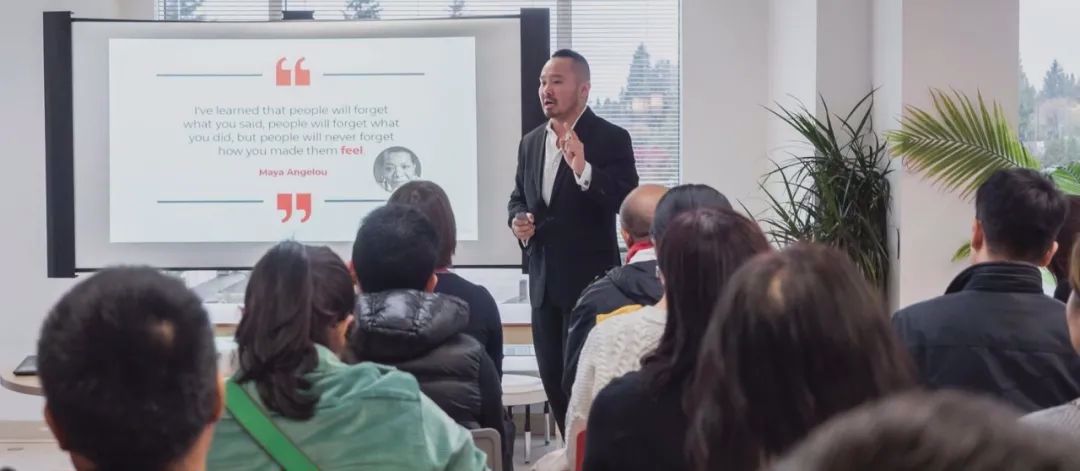
第一讲中我们将探讨以下重点,利用有限时间弯道超车:
1. 2020-21北美本科申请趋势回顾
2. 北美本科申请材料要求讲解
3. 校方侧重考察点揭密
4. 有限时间下,如何合理制定高效准备计划
适合人群:
11年级和12年级的高中生
日期&地址:
温哥华时间:2021年 9月 15号(周三) 下午7点
北京时间:2021年9月16号(周四)上午10点
活动流程:
7:00 – 8:30 主题探讨(北京时间:10-12:30)
8:30 – 9:00 Q&A(北京时间:12:30-1)


让 KEY 拥抱你
记得这是一个有温度的教育公众号