

















【温哥华乐活网综述】说起教师罢工,对于BC省的家长来说,这似乎已经不再算是新闻——2012年就曾经有过声势浩大的教师罢工活动。表面上,这次罢工的起因是BC教师联会(BCTF)与省府的新合约谈判陷入僵局,加上不满政府减薪威胁而导致。然而,实际上的原因各不相同:省府并没有打算在谈判桌上摆出足够的钱,而教师工会也不曾给与多少信任。
持久而糟糕的谈判历史
教师协会和省府对彼此的不满情绪可以追溯到20年前。了解这段历史有助于理解为何劳资两方都倾向于使用对抗性的措施来迫使对方屈服。
以下翻译来自重慶崽儿在北美的博客:
1987年:社信党省长(Social Credit Premier)Bill Vander Zalm政府引入立法,允许教师罢工,并建立教师学校改变工会结构。
改变工会构成导致了一个注册狂潮,BC省99%的教师都加入了BCTF。
此时,劳资谈判只在个别地区的教师和学区发生。
1988年-1992年:学区的教师工会都是与地方讨价还价。
Kitmat是第一个使用新法律,用罢工进行示威的学区。当时,工会要求18.5%的两年期涨薪幅度,该学区只肯提供9%。180名教师在谈判陷入僵局后离开了工作岗位10天。教师最终赢得了14.7%的复利增长工资。
这期间教师共进行了48次罢工,与政府进行了3轮谈判。
1993年:新民主党(NDP)政府立法打击素里和温哥华的教师罢工,强迫他们回去工作。
1994年:NDP政府立法规定,教联必须与省级部门讨论他们的要求。政府称之为“whipsawing效应”。地区谈判使教师能够挑选力量薄弱的地区,从而获胜,然后用这个成绩去影响其他地区的谈判收益。教师反对这个说法。
1996年:NDP政府在选举前暂时冻结了公共部门的罢工权。BCTF与BC公校雇主协会(BCPSEA)达成了过渡协议,推翻了之前的规定。
1998年:BCTF直接与省府谈判,协议内容包括减少k-3级的每班学生人数;改变非注册教师比例以及增加教师随叫随到的工资及更改相关规定。政府的BC公校雇主协会称,他们不会批准。教师协会直接与当时的总理格伦.克拉克(Glen Clark)联系,并将其立法。
2002年:BC自由党政府通过了必要的法律,限制教师罢工的权利。BCTF说,学校董事会正试图将剥夺他们非注册教师、辅导员、图书管理员以及每班学生人数的协议和合同。工会举行了罢工投票,有91.4%的教师表示赞同。2011年秋天,教师们只做了有限的工作――取消了所有的课外活动和行政服务。
2002年:政府立法规定与教师的现有合同将持续到2004年,教师们称之为“黑色星期五”。教联教师获得了7.5%的3年涨薪,但是地方学区不会得到省府的资金支持。政府还剥夺了工会对班级人数及组成的谈判能力–这个问题最终走上了BC最高法院。为此,教师举行了一天的罢工。
2005年:政府委任的实情调查员(fact-finder)裁定双方处于僵局状态,无法用谈判解决。自由党政府强行立法,3年无涨薪并延长合同期限至2006年。教师工会以88.4%的赞同率同意罢工。从10月7日至21日,教师离开了工作岗位长达10个工作日。BCTF因为抗拒劳工关系局(LRB)的要求、蔑视法庭而被要求马上恢复工作。数日后,调解员提出暂停罢工的要求,77%的教师投票同意暂停罢工,并在10月24日恢复工作。
2006年:卡玲.泰勒(Carole Taylor)提出给每名教师3700加币的一次性签约奖金,合同时间为4年。教师们投票支持罢工,在上一份协议马上就要过期的时候,他们最后达成了每个签约教师可以收到4000元的签约奖金,附加5年内涨薪16%的合同。
这是在升级谈判中,BCTF与BCPSEA首次达成了经自由协商的省级集体协议(freely negotiated provincial collective agreement)。
2012年:在几个月的消极工作后,教联举行了3天的罢工行动。政府立法设立了冷静期,之后,BCTF与BCPSEA达成一项从2011年开始的协议,增加休假规定。老师们同时表示,他们要对政府试图取消教师资历的行为进行反击。
2014年:BC高等法院在1月27日裁定省府限制教联谈判权的做法违反宪法,并表示,省府根本不打算与BCTF谈判,对此应向教联赔偿200万元,并且恢复2002年的班级人数标准。
BCTF主席曾劝说省府不要上诉,但是省府表示,法院裁决只考虑了教联的利益,如果要恢复2002年的标准,省府的教育支出将多达10亿,因此决定上诉。
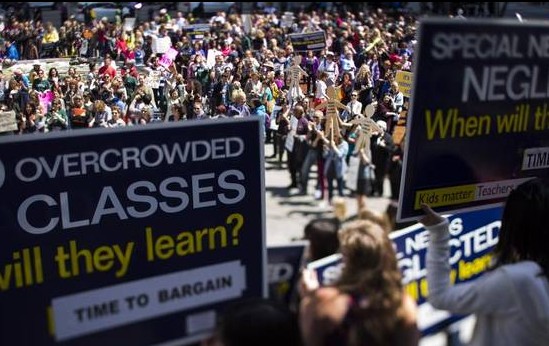
5月21日,BCTF宣布,下周将开始轮流罢工,而劳资双方现在在工资、班级规模及组成等各个方面的要求仍相距甚远。
各有道理 互相指责对方伤害学生
罢工给普通学生和家长的生活带来很大的不便。学生不能按时上课,不能使用已经付费的健身和休闲设施,在这个毕业的季节,许多家长担心自己的孩子无法顺利的度过这段本来应该值得纪念的日子。
有学生家长表示,一方面他赞成教师罢工。班级的庞大人数和削减支援人员已达到不受控制的地步,现在的教师工作的确是相当吃力。但另一方面,如果谈判无法进行下去,没有人能够为这些出格的对抗行为负责,直接受害的是学生以及家长。
省报专栏评论员迈克尔.史密斯(Michael Smyth)也在文章中指出,教联和省府应该成熟面对谈判,而不应该像小孩一样赌气。现在全省55万学生面临停课,不应该将他们作为对抗的武器。
对于BC教师来说,他们的委屈由来已久。2005年秋天,加拿大BC省的教师举行罢工。但是,这个行动随后从合法变成违法。当时省府为了报复教联的罢工,在周日迅速通过一项法律,将教育工作定性为“必要的服务”,使任何教师罢工行动变成非法。教师本来打算罢工2天就结束,而政府通过的新法例违反宪法,省府的这种强硬行动,教师们难以接受。
教师们认为,把教育工作视为必要服务是不合理的,因为欠缺教师并不会对人们的生命和生活构成即时危险。教育服务有别于警察、消防队和救护车的服务,它不是一种24小时全天候、关乎生死的服务。
还有教师表示,BC省教师与当时的省政府(NDP政府)签定合约不会加薪,但取而代之的是缩减课堂人数至合理水平。此合约效力维持了几年,直至自由党政府上台,他们自行决定在教师合约中剔除此部份。
之后,自由党政府的做法更过份,告诉教师们在“谈判桌上”不可谈及“课堂人数、增加薪酬、工作环境”,跟着说“现在我们可以开始讨论合约问题了”。这样的态度使教师们没有任何提出要求的余地。
而省府则不愿谈及以前的例子,他们简单的表示,他们已经退让了很多。
加拿大2010-11年度统计报告声称,BC省老师的平均工资是80582加元,在加拿大各省中居第二位。
附:英文资料 《教联罢工简史》
The two sides know that they have stoked the public’s anger and disbelief. In documents and in conversation, they concede that they have presided over a mess, using words like “dysfunctional” and “tortured.” But a look at the history of the relationship between teachers and governments makes it clear that the real surprise in the current conflict would have been an amicable and quick settlement. Through decades of trench warfare, more than a generation of rival negotiators based out of Victoria and the B.C Teachers’ Federation offices in Vancouver have built up a mythology of past wrongs that continue to influence the discussion at the bargaining table.
The relationship between B.C. governments of all political leanings and the province’s teachers over the past three decades has been unparalleled.
Since teachers won the right to collective bargaining in 1987 there have been 52 strikes, a series of controversial legislation, bitter court battles and only a single new contract signed without the aid of strikes or legislation.
With all the angst created among students and parents during this conflict, neither side can claim victory. While B.C. students have some of the highest test scores in the country, those scores have been sliding, especially when compared to competitors overseas. If teachers had accepted the average contract in the public service over the past decade, they would be making considerably more today according to government documents. The union says wages have been stagnant since 2010. That poor showing is in spite of a string of legal and illegal strikes in 2002, 2005, 2011, 2012 and 2014.
“Resentment is woven into the DNA of both sides,” according to Thomas Fleming, a retired University of Victoria history professor who wrote a book on the relationship. “These two groups have haunted public schooling for 50 years in this province; the battle between them has been biblical.”
The modern relationship between the teachers’ union and the province started in 1987 when the Social Credit government of the day was forced to allow teachers to bargain collectively after a court challenge. For the next six years, the province saw the BCTF operate as a federation of 75 individual unions, one in each school board.
Each local union negotiated with a local school board. With the boards eschewing aid from Victoria, the BCTF-led unions had a string of successes, writing into collective agreements much of what the BCTF wants to preserve today.
One of the successes of the period was the introduction of union-led directions on class size and class composition – the main flashpoint in the current conflict. This meant the union would set the number of students and special-needs students in each class, determining how many teachers would need to be hired.
The union wins came at the cost of an average of 16 strikes during three rounds of negotiations from 1987 to 1994, according to the British Columbia Public School Employers’ Association.
In 1994, the BCPSEA was created as a counter-weight to the BCTF. It would negotiate for all of the province’s school boards from then on and teacher bargaining would also be centralized. Now you had two heavyweights in place to bargain over the conditions of the province’s teachers and the lives of students.
“They wanted to get back at us,” said Ken Novakowski, the BCTF’s executive director for much of the 2000s. “The school boards didn’t like that early period, they felt that they got beaten and that caused some of the attitude that BCPSEA picked up when they started negotiating.”
In the first provincewide negotiations in 1995, the BCTF vowed “no concessions.” According to Mr. Novakowski, the union was looking to raise teachers to the best contracts then found in the province. The government viewed the talks as a “blank slate.”
With no agreement possible, both sides agreed to extend the existing contracts to 1998. Attempts at a second agreement failed in 1998 and an NDP government resorted to legislating teachers back to work for the first time.
Everything changed in 2001. With the election of Gordon Campbell and the B.C. Liberals, the relationship worsened. “That was absolutely the point when the relationship broke down,” Mr. Novakowski said.
With the provincial economy facing severe headwinds and budgets slashed or frozen, Mr. Campbell and Ms. Clark, the new education minister, looked for savings in the province’s contract with its teachers.
With the BCTF seeking double-digit wage increases, Ms. Clark tabled two bills in January, 2002, that legislated an end to an impasse in negotiations and removed class size and composition language from the collective agreement with the BCTF.
“The government felt that the NDP had lost managerial control and cost controls over the system,” said George Abbott, then a junior minister in the government.
“I think that retrospectively they would have done things differently, including the amount they consulted with the teachers.”
More than a decade later, Mr. Novakowski wipes tears from his eyes when he remembers the day Ms. Clark tabled the legislation. The BCTF had only received a few hours’ notice of what was in the two bills.
“That was one of the most emotional moments for a lot of teachers who had sacrificed, worked hard and believed in what they were doing. And then to have it all taken away like that, without any consideration,” he said.
(The BCTF contested the 2002 legislation. In 2011, the union won and the government was ordered to restore the language. In 2014, the BCTF won another case on the same legislation. The government is currently waiting on an appeal.)
In 2005, the province’s teachers launched an illegal strike after they were legislated back to work for the third time in a row. Months later, an agreement was reached. The relationship remained acrimonious.
Charles Jago, appointed mediator between the two sides in 2011, was struck by the currents running through negotiations. “The mindset of the BCTF was fascinating to me,” he said. “Their sense of grievance goes back 40 years. It is real and palpable and is played out at the table. They can’t overcome the past.”
After months of low-level job action and a strike, Mr. Jago reached a short-term deal that ended in 2013.
“My biggest regret after 34 years in politics was that I wasn’t able to turn a corner in the relationship between the government and the BCTF,” said Mr. Abbott, who was education minister in 2011.
Now in negotiation again, both sides appear to be close to a six-year deal. The contract would be the longest yet. The BCTF is still fighting to regain what it first won in the 1980s, kept through the 1990s and lost in 2002.
Ms. Clark has pledged to end the current cycle of animosity, now in its 27th year. The government will not legislate an end to the current conflict, leaving both sides to hammer out a deal.
And the day after a new deal is signed, the B.C. Liberals say they will start negotiating a 10-year contract, long enough perhaps for a generation to forget the past.
本文发布于: 2014-9-10 13:41