







大批中国大陆移民在温哥华寻求避风港,温哥华40%的豪宅随之落入亚洲买家手中,而这个海滨城市渐渐成为全球别墅圣地。虽然注入的投资令当地经济受益,但全球迁徙导致了当地房价飙升和种族关系紧张等一连串问题。日益增长的全球化在温哥华社区引起激烈的辩论,而当地居民对此也反响不一。
40% of Vancouver luxury homes went to Asian buyers as Waves of Chinese immigrants seek safe haven in this coast city, turning Vancouver into a global resort community. But the growing globalization has sparked heated debates and divergent reactions from Vancouver communities. While the fresh investments have benefited the local economy, a slew of problems rise – from soaring home prices to racial tensions.
(大中报泊然报道)一位中国富豪的豪宅位于西温哥华,里面不仅有时尚的热水浴缸,还有大型游泳池,站在露台上极目眺望,海洋、山区和城市的醉人美景都可以尽收眼底。
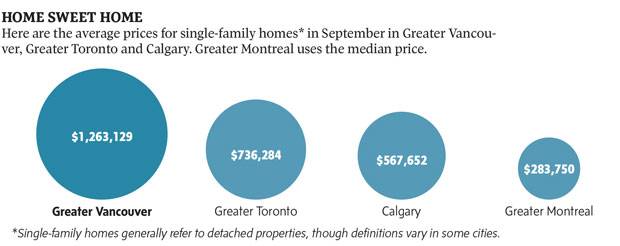
在中国大陆富裕移民的推动下,温哥华成为加拿大价格最高昂的房地产市场。目前温哥华独立屋的平均价格已经达到$126万元,高于其他所有加国城市。随着来自太平洋彼岸移民的外资源源不断地涌入,温哥华也变成名副其实的全球性房地产市场。据一家大型地产公司估计,去年经该公司售出的温市独立屋中大约有三分之一落入大陆买家手中。温哥华的开发商和房地产公司都赚得盆满钵满,有些公司因此在上海和北京设立了办事处。在一些人看来,温哥华已经成为全球的睡房社区。
但是由于温哥华当地居民的收入增幅远远落后于房价涨幅,从而引发了人们对房屋负担能力的担忧。这也导致温市的中层甚至是中上阶层改为永久租房或是移居到本拿比等更便宜的郊区。由于联邦政府现时并未搜集有关外国买家在加国置业的数据,因此相关的资料很有限。与此同时,温哥华炽热的楼市也引发了激烈的辩论,其中包括相关的种族歧视指控,以及当局是否应该采取措施遏制外国买家,或是否目前的状况在所难免,人们应该对自由市场的全球化持欢迎态度。
一些热情洋溢的中国富豪在温哥华并不仅仅只是购置房产,他们还一起创办了一个慈善团体,该团体刚刚请1,000名老人享用了感恩节午餐,最近还为当地的医院和宠物庇护所募集了$25万元捐款。
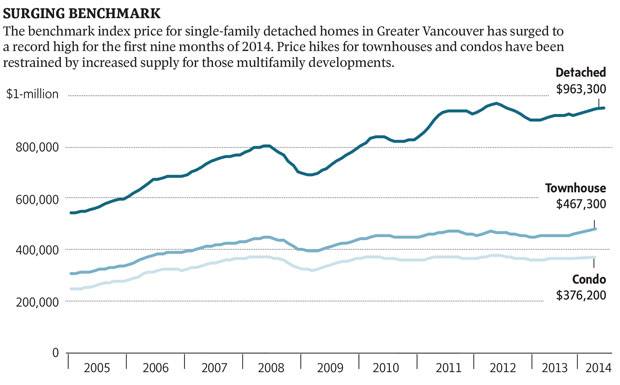
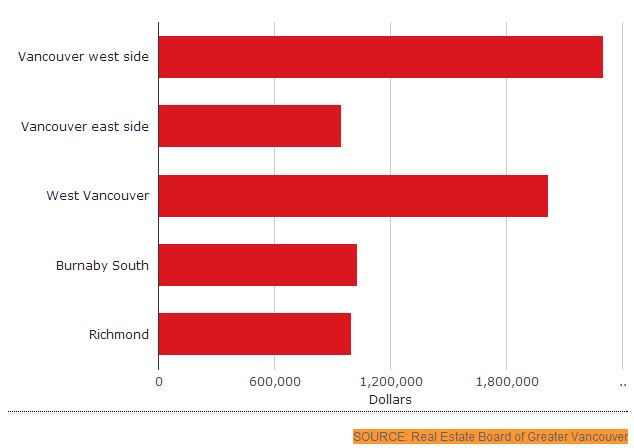
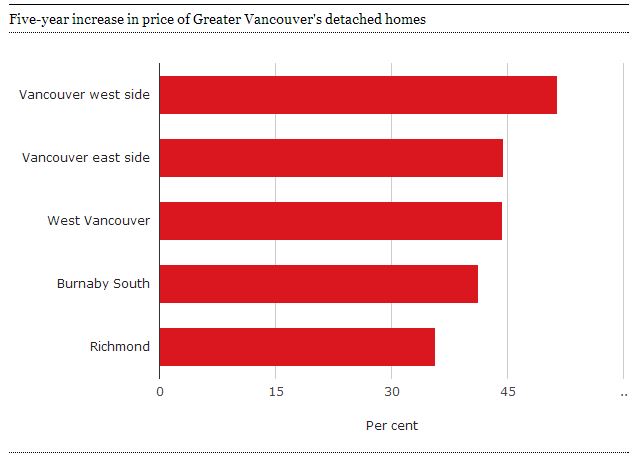
温哥华炽热的楼市与一些时尚社区的独立屋需求飙涨密切相关。当地的大部分顶级物业都集中在温哥华的西侧和东侧,西温哥华、列治文和本拿比。在温哥华西侧,剔除最昂贵转售物业后的独立屋均价在过去五年里飙升了51.5%,已经涨至近$230万元。
温哥华的Macdonald Realty Ltd公司是卑诗省最大的房地产公司之一,该公司副总裁斯卡罗(Dan Scarrow)最近刚刚在上海设立办事处,以便在中国寻找潜在的高端物业买家。但斯卡罗对此毫无歉意,他表示在该公司去年售出的531套温市独立屋中,有178套(或33.5%)的买家与中国大陆有关联。
在斯卡罗于上海寻求投资者时,他打算向无意在温哥华定居的潜在买家推荐当地的商业地产。但是由于一些外国买家在温市置业纯粹是为了投资,并因此将房屋空置或是出租,从而也引发了一些怨言,因为有时候这被视为是损害社区活力。
但是总体来看,斯卡罗认为外资带来的好处远远大于其负面影响。婴儿潮一代可以从中获利,并因此拥有足够的资金去帮助他们的子女。此外,房屋销售也促进了家电家具销售和房屋装修业务。温哥华的房地产市场本身已经变成一个重要的生态系统,这也可以解释为什么开发商都渴望外资的流入。
如今,移民已经成为大温哥华深感骄傲的多元文化历史和现在的国际化身份的一部分,例如现在在列治文郊区的人口中有近半是华裔,其也因此成为加拿大最大的“中国城”。
富豪投资者
为中国富裕移民工作的移民律师李克伦(Richard Kurland)称,以前涌入温哥华的亚洲移民和现在涌入的富裕投资者之间的主要区别在于“中国大陆经济的巨大规模”。
中国是全世界人口最多的国家,其经济飞速发展创造了庞大的新兴富豪阶层。据巴克莱(Barclays Plc.)的调查显示,近半数的中国大陆有钱人都考虑在未来五年移民发达国家。
在过去十年,至少已有3万中国大陆富豪通过联邦政府的投资移民项目移民卑诗省,在他们当中有近半数定居温哥华。按照联邦投资移民项目的规定,移民申请人只要拥有$160万元净资产,并同意向政府提供$80万元无息贷款,就可以获得加国永久居民身份。联邦政府在2014年预算案中终止投资移民项目,当时联邦投资移民申请积压了8万多份,其中大约80%的申请都是来自中国大陆,预期该移民项目很快就会重开。
虽然中国富豪移民的需求持续旺盛,但由于土地有限,温哥华的物业,尤其是独立屋的供应仍然受到限制。苏富比2013年公布的一份报告称,温市40%的豪宅被外国买家买走,其中大部分买家都是来自中国大陆、伊朗和美国。
另一位温哥华移民律师罗森伯格(Ryan Rosenberg)称,中国富豪将温哥华视为避风港,但是一些移民仍然会将大部分时间花在海外,尤其是那些将妻儿留在温哥华的商人。罗森伯格称,如果中国是他们赚钱的地方,那加拿大就是存钱的地方,加拿大移民身份是全世界最有保障的保单之一,而温哥华也变成了国际化的睡房社区。
负担能力问题
对于都是从事护士职业的万德罗斯(Brent VanderRose)和妻子艾米(Amy)来说,温哥华的房价已经越来越难以负担。在几年前,万德罗斯花$38.5万元在温哥华的Fairview社区购买了一套面积643平方英尺的二手一居室公寓,他和妻子都很喜欢这个社区,并且他们骑单车就可以去上班,但是他们在附近却买不起更大的房子。
万德罗斯夫妇最终决定在素里郊区购买一套价格为$58.5万元的三居室独立屋,但是他们却未能在迁入日期前出售他们的旧公寓。因为无力负担两份按揭贷款,并且公寓委员会规则禁止他们转租公寓,因此他们只能将新屋出租,但这给他们造成每月$500元的损失,此后他们又不得不带着新生婴儿住进转租屋,并将宠物猫狗寄养在亲戚家。最终,他们以$33.5万元的价格将旧公寓亏本出售。虽然他们正等待另一个孩子诞生,但是由于房价太高,他们表示只会要两个孩子。
万德罗斯夫妇是温哥华两极分化的房地产热潮中的典型代表,虽然独立屋业主获得巨大的回报,但公寓和镇屋业主有时候只会在萧条的市场中获得微弱的回报,甚至还会亏本。
由于许多学生和教师都找不到负担得起的房屋,卑诗大学推出了住房行动计划,承诺建造更多的经济适用房,但是由于当地的房价持续飙升,甚至连高薪的专业人士也感觉高不可攀,卑诗大学的计划只不过是杯水车薪。卑诗大学亚洲研究院院长肖逸夫(Yves Tiberghien)有两个孩子,但他目前仍在租房,他称在当地定居是不可能的事,因为大学教师的工资根本买不起房。
据美国物业顾问公司Demographia的报告称,温哥华已经成为世界上仅次于香港的房价第二贵的城市,其房价是当地居民家庭收入中值的10.3倍。与此同时,无力负担也会导致恶性循环,因为极度难以负担的市场会吸引更多寻求高额投资回报的买家,而这会进一步推高房价。
种族问题
由于一些人认为当局应该采取一些措施提高居民的住房负担能力,但还有些人希望外资继续源源不断地涌入,因此在温哥华引发了激烈的辩论。但是由于缺乏数据,并且涉及到种族歧视指控,相关辩论变得十分混乱。
此外,卑诗省的中国大陆移民和早期香港移民之间的微妙紧张关系也令相关辩论变得更加复杂,因为一些相关移民认为大陆移民的财富是通过在国家计划经济中暗箱操作、接近政府官员或是贪污得来。
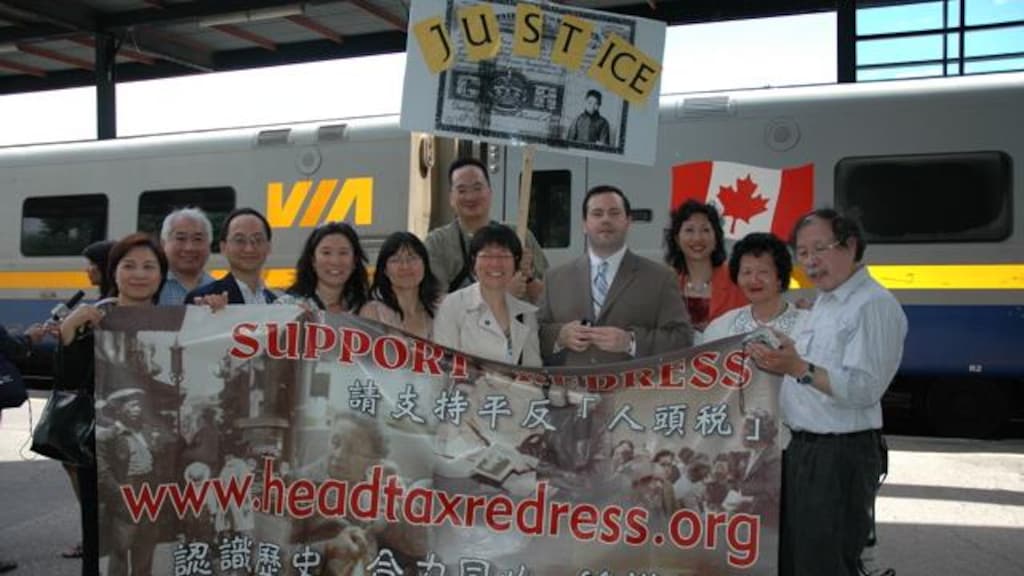
全美房地产经纪人协会(National Association of Realtors)知道在美国房屋销售总额中,有8%($922亿美元)是来自外国买家,其中中国买家占到24%。他们还知道亚洲买家更钟情于西海岸的物业。而加拿大却没有类似的数据,但是有些人喜欢这样。曾于2010年出版《富豪移民》(Millionaire Migrants)一书的卑诗大学地理教授雷伊(David Ley)称,有些开发商一直声称种族歧视压制了有关外国投资的讨论。有一名开发商称,限制外国投资类似曾对中国移民征收的人头税,还有些开发商认为限制外国投资是种族歧视,或是煽动有关投资来源国的讨论。
温哥华开发商Westbank公司的总裁吉莱斯皮(Ian Gillespie)表示,这就是种族歧视,虽然他不会说出来,但的确会这样想。
一直设法淡化有关境外投资讨论的房地产行业认为外国投资并不是问题。卑诗省地产协会首席经济师缪尔(Cameron Muir)表示,有中国人的名字并不意味着就一定是外国投资者。
许多人仍然不确定能够通过何种措施限制外国买家。统计数据显示外国买家购房已经成为温哥华现象,但拥有行动权的上级政府未必会重视。参加温哥华市长选举的华裔候选人Meena Wong,曾建议通过对空置房征税资助经济适用房。
新加坡最近就将针对外国买家的印花税税率提高到购买房价的15%,而永久居民的印花税税率仅为5%。此外,英国政府也在2014年预算案中提出对购买£50万英镑以上房屋的买家征收15%的印花税。
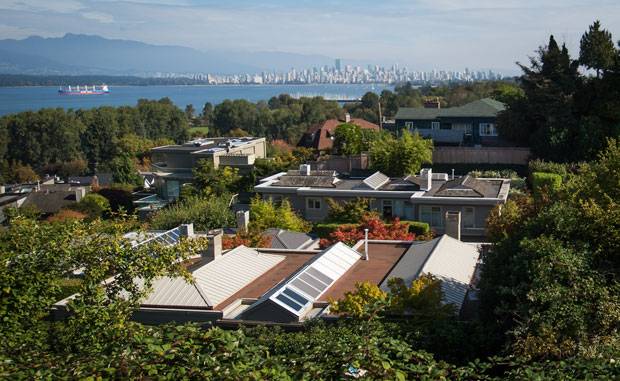
The view from David Ren’s patio at his home in Vancouver. IAIN MARLOW/GLOBE AND MAIL
中国电讯设备商David Ren数年前花了近$300万元在西温哥购买了一套海景房,他认为开放政策可以促进繁荣。David Ren将温哥华的房地产市场和中国青岛的海鲜市场相提并论,他称,在数十年前,因为只有其家乡的居民购买海鲜,海鲜的价格非常低;但是随着中国经济飞速发展,青岛渔民发现他们可以将产品销往全球市场,当地的海鲜价格因此水涨船高。
David Ren称,这既是全球化,只要温哥华欢迎移民,就会有人愿意移居到这里,而当地的房价自然就会上涨。温哥华的居民面临的抉择就是:是欢迎外国投资带来的好处,还是拒绝全球化。
Vancouver’s real estate boom: The rising price of ‘heaven’
IAIN MARLOW AND BRENT JANG
VANCOUVER — The Globe and Mail
Published Friday, Oct. 10 2014, 7:11 PM EDT
Last updated Tuesday, Oct. 14 2014, 8:32 AM EDT
Qiqi Hong walks past her sleek, blue-tiled hot tub and an infinity pool that seems to disappear like a waterfall into the chilly air above West Vancouver. She leans on the patio railing and breathes in the majestic ocean view that takes in the towering Douglas firs of Stanley Park, the skyscrapers of Vancouver, the Asia-bound freighters anchored in English Bay and – way off in the misty distance – the faint, rugged outline of Gabriola Island.
“We’re in heaven,” says Ms. Hong. “I can’t find any house that can compare to my house.”
The serene West Coast lifestyle did not come cheaply: Ms. Hong’s home cost $6-million. But it is an investment she can easily afford. The irrepressible businesswoman founded a successful lighting-design business in Beijing that thrived in China’s building boom. It now has more than 100 employees. But tired of Beijing’s hectic pace and foul air, she decided to come to Vancouver – after looking in Switzerland, Germany and the United States – on the Canadian government’s immigrant investor program in 2011. She now also owns three other houses on Vancouver’s west side, each valued in excess of $1.3-million, as well as a downtown condo she uses on weekends and lends to visiting friends.
Demand from wealthy migrants from mainland China such as Ms. Hong has helped make the Vancouver area the most expensive real estate market in Canada. The average price of a single-family detached home is $1.26-million, higher than any other Canadian city. The rising flow of foreign capital – stemming from a long tradition of transpacific migration and investment – has turned Vancouver into a truly global real estate market. One large real estate firm calculated that roughly one-third of the detached homes it sold within the City of Vancouver last year went to buyers from China. Vancouver developers and real estate firms have hit the jackpot, and some have rushed to set up offices in Shanghai and Beijing. Some now say Vancouver is a bedroom community for the world.
The upscale Point Grey neighbourhood is on Vancouver’s west side, where benchmark prices for detached homes have soared. DARRYL DYCK FOR THE GLOBE AND MAIL
But Vancouver real estate prices have also become increasingly unhinged from local incomes, prompting concerns about affordability. It has led to middle– and even upper-middle class Vancouverites renting permanently or fleeing for cheaper suburbs such as Burnaby. There is a search for better data on foreign buyers, which is only haphazardly tracked. There is now a heated debate – that includes accusations of racism – about whether anything should be done to curb foreign buying, or if what is happening is simply an inevitable, and welcome, facet of globalization in a free market.
After all, the ebullient Ms. Hong hasn’t just bought houses here. She founded a charity with other wealthy migrants from China; the group just held a Thanksgiving lunch for 1,000 seniors and recently collected $250,000 for a local hospital and pet shelter. She has founded several businesses in Vancouver, including one in real estate, and drives to ESL classes. She’s learning English, and has even joined a protest, hitting the streets during the recent B.C. teachers’ strike. While she stays busy in Vancouver, her husband frequently flies to China to manage the firm.
“In my opinion, I think it’s good for the economy,” Ms. Hong says, noting that the number of Chinese residents on her street has soared in recent years and that the local businessman she bought her house from made a cool $1.5-million more than he originally paid. “In Vancouver,” Ms. Hong says, “the house prices are perfect.”
Chinese entrepreneur Qiqi Hong left Beijing to live in West Vancouver. The $6-million property is one of five that she owns in the city. IAIN MARLOW/GLOBE AND MAIL
Vancouver’s housing boom has much to do with soaring demand for detached homes in tony neighbourhoods. Vancouver’s west and east sides, West Vancouver, Richmond and large pockets of Burnaby have most of the region’s top-tier properties. On Vancouver’s west side, detached home prices soared 51.5 per cent over the past five years to nearly $2.3-million for the benchmark index, which strips out the most expensive resale properties.
Dan Scarrow, who recently opened an office in Shanghai for Vancouver-based Macdonald Realty Ltd., one of the largest real estate firms in British Columbia, makes no apologies for courting prospective home buyers in China. He says 178 of the firm’s 531 sales of single-family detached homes within Vancouver’s city limits last year – or 33.5 per cent – went to buyers with ties to China.
“Vancouver has become a global resort city. The prices have decoupled from local wages,” says Mr. Scarrow, whose mother, Lynn Hsu, moved from Taiwan to Vancouver in 1979 and is now president and majority owner of Macdonald Realty.
As he pursues investors in Shanghai, he intends to steer buyers toward commercial properties if they have no interest in settling down in Vancouver. Some foreign buyers have purchased Vancouver real estate purely as an investment, without occupying the properties or renting them out, but that has triggered some resentment because it’s sometimes seen as detracting from the vitality of a neighbourhood.
But in general, Mr. Scarrow believes the positives of offshore money far outweigh negatives. Baby boomers can cash out at a profit and downsize with enough money left to help out their children. Selling houses also increases sales of appliances, furniture and home renovations. Vancouver’s housing market has become an important ecosystem unto itself, which explains why developers are anxious to keep foreign money flowing.
On the rise: Prices have climbed sharply for Greater Vancouver’s single-family detached homes
*Benchmark price: September home price index that strips out the most expensive detached resale properties sold on Multiple Listing Service.
SOURCE: Real Estate Board of Greater Vancouver
Five-year increase in price of Greater Vancouver’s detached homes
SOURCE: Real Estate Board of Greater Vancouver
The twentieth century’s geopolitical turmoil sent wave after wave of Asian migrants across the ocean. Some fled Mao’s China. Taiwanese moved during cross-strait tension. Sikhs arrived after persecution in India. Many Persians have fled Iran. One of the biggest waves came in the late 1980s and 1990s, as wealthy Hong Kong residents – flush from a housing boom there – sought a more stable home ahead of the 1997 handover.
Hong Kong investment in Vancouver real estate had been going on for years, but real estate companies began marketing massive new developements in Vancouver and Richmond. In 1988, Li Ka-shing, the richest man in Asia, bought the 203-acre Expo 86 site in Vancouver for what would become Concord Pacific Place. David Choi, the entrepreneurial founder of Royal Pacific Realty who sold real estate in Hong Kong, puts it this way: “Hong Kong people don’t vote with their hands,” he says. “They vote with their feet.”
That migration is part of Greater Vancouver’s proud, multicultural history and present cosmopolitan identity: The population in the suburb of Richmond, for example, is now nearly 50 per cent Chinese, the most ethnically Chinese city in Canada.
‘Millionaire investors’
Richard Kurland, an immigration lawyer who works with wealthy Chinese migrants, says “the main difference” between previous waves of Asian immigration to Vancouver and the current flow of wealthy investors is “the mega-size of the [Mainland] Chinese economy.”
The tectonic economic rise of China has created – in the most populous country on Earth – an enormous new millionaire class. And nearly half of all wealthy people in China also want to immigrate to a developed country within five years, according to a Barclays PLC survey.
At least 30,000 millionaires from Mainland China have immigrated to B.C. over the past decade using the federal government’s investor immigrant program, almost all of them settling in Vancouver. The federal program allowed those with a net worth of $1.6-million to lend the government $800,000 interest-free in exchange for permanent residency. The program was ended in the 2014 budget – with a backlog of 80,000 applicants, roughly 80 per cent of which were from Mainland China – but is expected to be relaunched soon.
“We’re going to continue to get a solid supply of millionaire investors,” Mr. Kurland says.
While Chinese demand is practically unlimited, supply in Vancouver – particularly for detached homes – remains restricted: There are mountains to the north, the U.S. border to the south, the agricultural land reserve, multiple rivers and bridges, and the vast Stanley Park. “There’s not a lot of dirt here,” says David Goodman, a principal at real estate firm HQ Commercial.
A 2013 report from Sotheby’s said 40 per cent of Vancouver’s luxury home sales went to foreign buyers – mostly buyers from Mainland China, but also from Iran and the U.S.
Ryan Rosenberg, another Vancouver-based immigration lawyer, says wealthy Chinese see Vancouver as a safe haven. Some immigrants, however, still spend much of their time overseas, especially businessmen who leave their wife and child in Vancouver, he says. At some luxury homes on Vancouver’s west side, he notes, agents have noticed a pattern: A lot of master bedroom closets contain only women’s clothing. “If China is a place to make money, Canada is a place to save it,” he says. “Canadian immigration status is one of the world’s best insurance policies. Vancouver has become an international bedroom community.”
The affordability problem
The Vancouver housing market has been less kind to Brent VanderRose and his wife Amy, who are both nurses. A few years ago, Mr. VanderRose purchased an older one-bedroom, 643-square-foot condo in Vancouver’s Fairview neighbourhood for $385,000. He and his wife Amy loved the neighbourhood and the ability to bike to work, and wanted to start a family there. But they could not afford a bigger place nearby. “It was really disheartening,” he says. “I feel like it’s a Canadian right to own a home.”
The VanderRoses finally decided on a $585,000 detached, three-bedroom home in the suburb of Surrey, but couldn’t sell their older condo before the move-in date. Because they couldn’t afford two mortgages and condo board rules meant they couldn’t sublet their property, they rented out the new house at a $500-a-month loss, moved into a sublet with their newborn, and temporarily sent the cat and dog to in-laws. They finally sold the condo at a loss for $335,000. They are expecting another child, but say they are stopping at two – because of housing costs.
This is typical of Vancouver’s polarized boom: While owners of detached homes see big returns, condo and townhouse owners sometimes see little gains in a flat market, or lose out.
Although it’s surrounded by some of the priciest real estate in the city, the University of British Columbia has been sideswiped by the boom, since many students and faculty can’t find affordable housing. The university launched a housing action plan, pledging to build more affordable housing, but it can do little as prices for local properties rise beyond the reach of even well-paid professionals. Yves Tiberghien, director of UBC’s Institute of Asian Research, joined UBC in 2001 and has two kids, but he is still renting. “I am much less attached to Vancouver, because settling down is impossible,” he says. “An academic salary cannot allow someone any more to buy a family home, especially if you don’t have time to commute far.”
After Hong Kong, Vancouver is now the second most unaffordable city in the world with house prices 10.3 times the median household income, according to a 2014 report from the Demographia research firm. Unaffordability is also a vicious circle. “Severely unaffordable markets are also more attractive to buyers seeking extraordinary returns on investment,” the report says, which in turn raises prices further.
“What is interesting about Vancouver is how disproportionate the affordability issue is, how big the house price is compared to the average income,” says David Ley, a UBC geography professor who wrote a book about Vancouver called Millionaire Migrants.
In his 2010 book, Mr. Ley shows that the rise in house prices were “prised loose” of local factors, and correlate almost perfectly with international migration to British Columbia. Vancouver now has the highest household debt as a percentage of annual income in Canada, he adds, citing a 2013 paper by University of Toronto professor Alan Walks. “In a bigger city, that effect might be a bit more diluted. But here, with 2.5 million people – with limited land for development – it has a huge impact.”
“In my opinion, I think it’s good for the economy,” Ms. Hong says. “In Vancouver, the house prices are perfect.” IAIN MARLOW/GLOBE AND MAIL
The race issue
That outsized impact has led to heated discussions in Vancouver, mainly between those who think something needs to be done about affordability and those who want to keep the foreign money flowing. These debates have been muddied by a lack of data and inflamed by accusations of racism.
They have also been complicated by subtle tensions between Mainland Chinese immigrants to B.C. and earlier arrivals from Hong Kong, some of whom assume wealth accumulated on the mainland is the result of rigged competition in a state-ordered economy, proximity to government officials – or corruption.
The U.S. National Association of Realtors knows that 8 per cent – $92.2-billion (U.S.) – of U.S. housing sales are from foreign buyers, and that Chinese buyers accounted for 24 per cent of that volume. They also know that Asian buyers prefer West Coast property. But in Canada there is no such data. And some like it that way. Developers, Mr. Ley says, have long claimed racism to suppress discussion of foreign investment. One developer says limits on foreign investment would “tread very close” to the Chinese head tax. Others suggest it is racist or inflammatory to even discuss the source country of investment.
“It is racism. Maybe I shouldn’t say that. It’s small thinking,” says Ian Gillespie, the chief executive officer of Westbank, a Vancouver developer with offices in China that built Vancouver’s Fairmont Pacific Rim hotel.
The real estate sector, which has played down talk of offshore investment, does not think foreign capital is an issue. “Just because you have a Chinese name doesn’t mean you’re a foreign investor,” says Cameron Muir, chief economist at the B.C. Real Estate Association.
Many remain unsure about what exactly could be done to restrict foreign buying. Statistics show foreign buying is a Vancouver phenomenon, but higher levels of government with power to act don’t necessarily care. One long-shot candidate in Vancouver’s mayoral race, Meena Wong, who is from China, suggested a tax on empty homes to fund affordable housing.
Some point to Singapore, which recently raised its tax – called a stamp duty – on foreign purchases of local real estate to 15 per cent of the purchase price, with a 5-per-cent tax on permanent residents. The British government, eyeing London, moved in the 2014 budget to have its 15-per-cent stamp duty on foreign buyers apply to a greater percentage of home sales, reducing the target threshold from £2-million to £500,000.
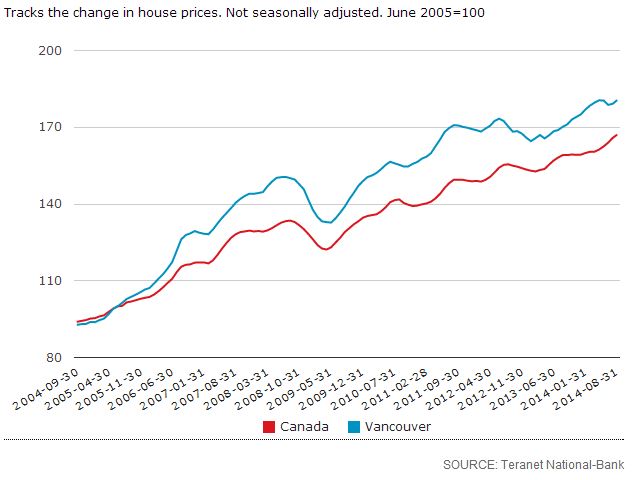
Teranet National-Bank Monthly House Price Index – Vancouver vs Canada
Tracks the change in house prices. Not seasonally adjusted. June 2005=100
SOURCE: Teranet National-Bank
David Ren, who made his fortune in telecom equipment and purchased his ocean-side West Vancouver home for about $3-million (Canadian) several years ago, says an open-door policy has brought prosperity.
Sitting on a gold-coloured couch with ornately carved wooden arms, he compares what is happening in Vancouver real estate to Qingdao’s fish market. Decades ago, only locals in his hometown bought seafood and prices were low. As China’s economy took off, Qingdao fisherfolk found they could sell to a global market, and locals saw prices soar.
“It’s globalization. As long as Vancouver welcomes immigrants, there will be people willing to move here – and inevitably prices will get driven up,” Mr. Ren says. “That’s the choice of Vancouverites: Whether we will welcome the benefits that come with this foreign investment, or whether we want to say no to globalization.”
As evening falls over the palatial lots of West Vancouver, Ms. Hong’s guests begin to arrive. Her husband Qing Feng is turning 51. And before the white bottles of Moutai baijiu (rice wine) come out, he is cooking amiably with his 10-year-old daughter, trying to recreate a ratatouille she has seen on YouTube.
He then prepares a feast of a dozen dishes with the wok on their gas stove: A whole fish, various vegetable dishes, stir-fried egg-and-tomato, a bowl of peanuts. Guests, including their friend Mr. Ren, toast Mr. Feng repeatedly. More baijiu is poured. Wine glasses are refilled. Lights twinkle on the far shore.
The ratatouille is roundly praised. But there is something about it that is not quite French. A Chinese guest, a former employee of Ms. Hong’s, asks Mr. Feng if he has tampered with the original recipe. He roars with approval. He has, indeed: Soy sauce, some spices, pork.
“Fusion!” he yells out.
Follow us on Twitter: Iain Marlow @iainmarlow, Brent Jang @brentcjang
本文发布于: 2014-10-15 09:54