
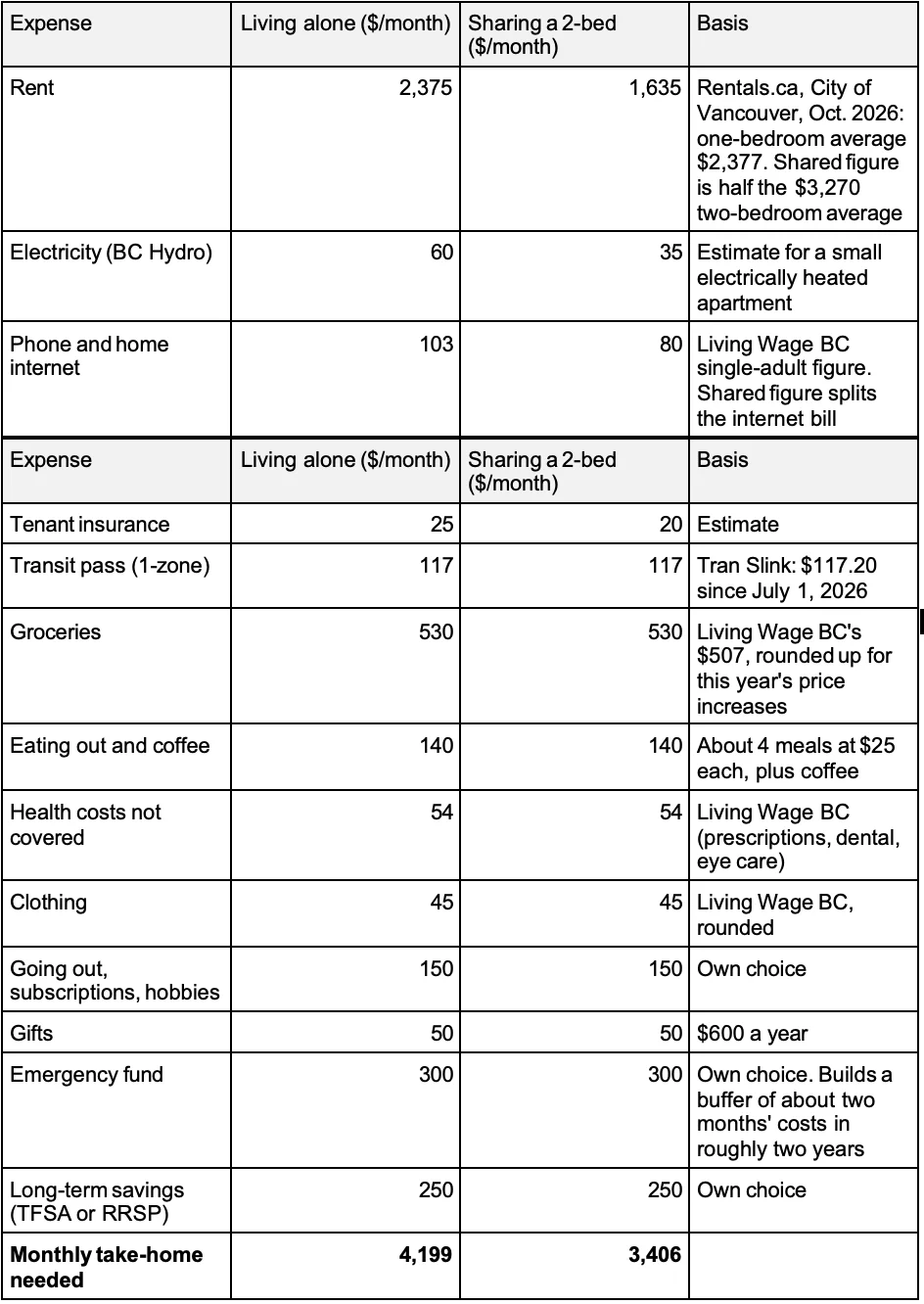
Let’s say a newly graduated student is starting their first full-time job in Vancouver and needs around $4,200 a month to live alone and still save. Before taxes, that would come to a salary of roughly around $64,000 a year. Sharing a two-bedroom with one roommate brings the take home figure down to about $3,405 a month, or around $50,400 a year.
The gap between the two numbers is practically and almost entirely rent.
What being “financially stable” means
With this budget, being stable means being able to cover every bill on time and still keeping savings. Here are some common expense areas and ways to budget:
❖ Housing: There are two choices, one is an unfurnished one-bedroom apartment. Another is half of a two-bedroom shared with one roommate.
❖ Transport: Use public transportation. A one-zone adult monthly pass covers buses anywhere in the region, plus SkyTrain within Vancouver.
❖ Food: Try to cook mostly at home, eating out about four times a month, and a few coffee trips a week.
❖ Savings: $300 a month to cover emergency fundings for things like dentists bills or broken phones and laptops. Another $250 a month can go to long term savings such as TFSA
❖ Others: $50 a month for gifts which is around $600 a year. Another $150 covers going out, subscriptions, and covering hobby expenses.
Living Wage BC also builds a similar budget for a single adult however they use a contingency fund instead of savings. That budget totals $3,476 a month.
The monthly budget
Rent makes up 57% of take-home pay for someone living alone, and 48% for someone sharing. Both are well above the usual guideline of 30%.
Renting a room in a larger shared house can cost less than half a two-bedroom. However, there is no official average for room rents, so this budget uses the two-bedroom figure.
From take-home pay to salary
To take home $4,200 a month, you need a salary of about $64,000 before taxes. To take home $3,405, you need about $50,400.

These figures use 2026 federal and B.C. income tax, along with CPP and EI deductions:
❖ Federal tax is 14% on the first $58,523 of taxable income, then 20.5%.
❖ B.C.’s lowest rate rose to 5.60% for 2026, on the first $50,363 of taxable income. The next band is taxed at 7.70%.
❖ Each government’s basic personal amount is tax-free. CPP takes 5.95% of earnings above $3,500, and EI takes about 1.6%.
The estimate assumes no other deductions such as workplace pension, union dues or extended health premiums. It also leaves out any tax refund. Your own pay stub may differ by a few hundred dollars a year, so you can check with the CRA payroll deductions calculator.
What the numbers show, and what they don’t
The numbers show that living alone on a typical starting salary is hard. However, it is possible.
❖ Sharing is close to the living wage. Living Wage BC puts the Metro Vancouver rate at $27.85 an hour. The shared-apartment budget needs about $25.85.
❖ Living alone takes more. It needs about $32.85 an hour, roughly $5 above the living wage.
❖ Many workers earn less than the living wage. Living Wage BC reports that more than half a million Metro Vancouver workers earn below it. That’s 36% of all paid employees in the region.
There are a few things the data can’t tell us:
❖ Asking rents vs. actual rents. The rent figures are asking rents for units listed now. Tenants who moved in years ago often pay less, because B.C. caps yearly increases for existing tenants. A new graduate is usually signing a new lease, so they pay the asking price.
❖ Room rents. There is no official average for a single room in a shared house.
❖ Rent averages hide a big range. Neighbourhood, building age and whether a unit is furnished all change the price by hundreds of dollars.
Sources
1. Rents: Daily Hive, “Vancouver rent just saw its first annual increase in nearly three years” (Rentals.ca data, Oct. 2026)
2. Living costs and living wage: Living Wage BC, Living Wage Report 2025 (Metro Vancouver)
3. Transit: TransLink, Pricing and Fare Zones
4. Federal tax: Canada Revenue Agency, 2026 tax rates and income brackets
5. B.C. tax: Government of B.C., Personal income tax rates
