
#BC省选 #尹大卫 #BC保守党#NDP
BC提前省选刚刚开打,第一份重磅民调就给尹大卫泼了一盆冷水。
Angus Reid调查显示,在已经决定或倾向某个政党的选民中,BC保守党支持率43%,NDP只有35%。大约十天前,同一家机构还是NDP领先4个百分点。更值得注意的是,62%的BC居民认为这场选举来得太早,只有21%认为时机合适。
这当然不能说明10月24日谁一定会赢。
20%的选民还没有决定投给谁,真正对自己目前选择“非常确定”的也只有35%。
但这组数字已经提出一个问题:BC会不会出现一场“愤怒投票”?
这里的“愤怒投票”不是民调机构使用的概念,而是一种政治现象。选民投票的第一动力,未必是多喜欢反对党,而可能只是已经很想惩罚现政府。
民调中,54%的人认为现在到了更换省政府的时候。换句话说,一部分选票可能首先是一张反对票,然后才是一张支持票。
尹大卫为什么偏偏现在大选?
NDP并不是一个已经失去执政能力的少数政府,原定省选要到2028年。尹大卫给出的理由,是特朗普贸易战和美国经济压力构成一个“生存性时刻”,BC需要重新获得选民授权。
美国压力当然存在。
问题是,议会没有瘫痪,政府也没有失去信任投票。既然NDP仍然可以继续执政,为什么非要提前两年?
看看当时的政治版图,就会发现这个时间窗口对NDP相当有利。
BC保守党刚刚经历严重内乱,党魁芬德利辞职,党团有人出走,洛恩·多克森刚刚接任临时党魁。
更巧的是,今年BC市选10月17日投票,省选10月24日投票,只差一个星期。
市选9月11日结束提名,9月18日是正常退出期限,9月19日正式进入竞选期。尹大卫9月22日才宣布省选。
这意味着,一批原本可能成为省级候选人的地方政治人物,已经投入市长、市议员和校董选举。
法律上不是绝对不能退出,但团队已经组了,钱已经花了,支持者也动员起来了。中途转战省选,需要付出很高的政治和信誉成本。
没有证据证明尹大卫就是为了“卡死”保守党候选人才选了这个日期。
但客观效果很清楚:这是一个BC保守党最难临时找人的时间窗口。
算盘打得很精,现实却出现了吊诡的一幕。
提前大选像突然吹响了集结号。原来另组新党的7名省议员迅速回归BC保守党,候选人也开始快速增加。
截至9月29日晚,BC保守党官网已经能数到大约72名有姓名的候选人。全省93个选区,正式提名到10月3日下午1点截止。
所以现在更值得问的,已经不是保守党能不能凑齐人数。
而是这些仓促补进来的候选人,质量到底怎么样?
这正好碰上这场选举最矛盾的一组数字:
54%的人说到了换政府的时候;
56%的人又认为BC保守党还没有准备好执政。
很多人可能已经想告别NDP,却还没有找到一个让自己放心告别NDP的办法。
这也可能是尹大卫目前最大的一张安全牌。
想换政府,和敢把政府交给另外一个党,中间还有一道门槛。
所以BC保守党现在必须证明三件事:有人、有政策,还有管理一个省的能力。
最近它已经开始拿政策出来。多克森承诺不增加新税,也不提高现有税率,并提出扩大LNG生产、缩短审批和稳定能源税费框架。
但“不加税”只回答了一半问题。BC仍然面对巨额赤字,支出怎么办、赤字怎么降,仍然需要更完整的财政方案。
尹大卫也开始加速出牌。
在资源领域,他提出五年内把BC关键矿产生产和出口扩大一倍,加快矿山审批,建设北海岸输电线,扩大本地冶炼、精炼和Prince Rupert港运输能力。
思路非常清楚:审批快一点,基础设施多一点,矿多挖一点,出口多一点。
可到了住房问题,他却拿出了另外一种政策工具。
9月25日,尹大卫提出提高投机与空置税,同时新增“未售公寓税”:公寓建成后空置超过一年仍未售出,第二年开始征2%,第三年3%,以后继续增加。
NDP认为,大温可能有大约5000套这样的公寓,通过增加持有成本,可以迫使开发商降价,把房子推向市场。
问题是,这套政治语言听起来非常熟悉。
十年前,大温房价快速上涨时,住房政治中最容易引起情绪的词就是:外国买家、中国资金、房地产投机和空置房。
2015年,时任NDP住房事务评论员的尹大卫,把温哥华西区一批房地产交易的土地登记资料交给城市规划师Andy Yan。随后有关“中国大陆买家”的研究引发巨大争议,因为判断买家背景的指标之一,是所谓“非英语化华人姓名”。
围绕“中国买家”“外国资金”和房价之间关系的讨论迅速扩大,也引发华人社区对污名化的强烈争议。
2016年,NDP进一步把房地产投机税方案带进省议会。原本并不接受这种思路的简蕙芝BC自由党政府,到了7月突然转向,对大温外国买家征收15%的额外物业转让税。具体税制与NDP原来的2%投机税并不完全相同,但NDP经营已久的“外国资金和房地产投机需要通过税收干预”这个政治议题,最终被执政党抢了过去。
到了2021年BC洗钱问题调查委员会听证会上,尹大卫再次被问到2015年的研究,并为自己参与其中以及给华人社区造成的影响表达了歉意。
十年过去,类似的词汇又重新回来了:外国投机者、空置房、囤房、开发商未售库存。
可是房地产市场已经变了。
BC房地产协会数据显示,今年8月住宅成交量比过去十年同期平均水平低25.4%,平均成交价同比下降1%,活跃挂牌量则接近2015年以来高位。
十年前大家问的是:为什么这么多人抢房?为什么房价一直涨?
今天需要回答的却多了几道题:为什么买家不买了?已经盖好的公寓为什么卖不掉?房价为什么仍然这么高?更重要的是,下一批房子,还有没有人愿意盖?
这也是“未售公寓税”真正需要回答的问题。
加拿大现在最大的住房政策压力之一,恰恰是供给不足。
字幕引用的CMHC最新估算显示,如果加拿大要在2036年前把住房可负担程度恢复到2019年的水平,每年需要建设约41.7万至46.9万套住房,而按照目前趋势,每年大约只能建设23.1万套。
如果一个项目本来就在盈亏边缘,未来房子卖不出去以后,还要承担逐年增加的库存税,那么开发商会不会干脆放弃启动?
现在没有证据能够确定这项税最终会减少多少新项目。它也可能在短期内逼出一部分库存、推动降价。
但政策不能只算今天这一笔账。
土地供给、地方开发收费、融资成本、人工材料、审批时间,本来已经构成住房建设的几笔硬成本。如果这些问题没有得到改善,却在项目建成、卖不出去以后继续增加税收压力,就必须回答:
今天逼出来几千套现有库存,会不会换来明天更少的新房开工?
最后还是回到这场大选。
54%的人想换政府,56%的人又觉得BC保守党没有准备好。
这两组数字并不矛盾。
它们恰恰说明BC现在存在一种非常典型的政治焦虑:对现政府不满,却还不确定替代者是否值得信任。
所以,“愤怒投票”能不能改变BC政局,最后并不只取决于省民对尹大卫有多不满。
还取决于BC保守党能不能在剩下的时间里,让选民把“还没准备好”这几个字拿掉。
如果做得到,现有的反政府情绪就可能找到出口。
如果做不到,选民即使生气,到了投票箱前仍然可能问一句:
换了以后,会不会更好?
尹大卫可以选择在对手最混乱的时候举行选举。
但这场提前大选最终会不会反过来,给原本没有准备好的对手一个迅速重新集结的理由,已经不是他一个人能够决定的了。
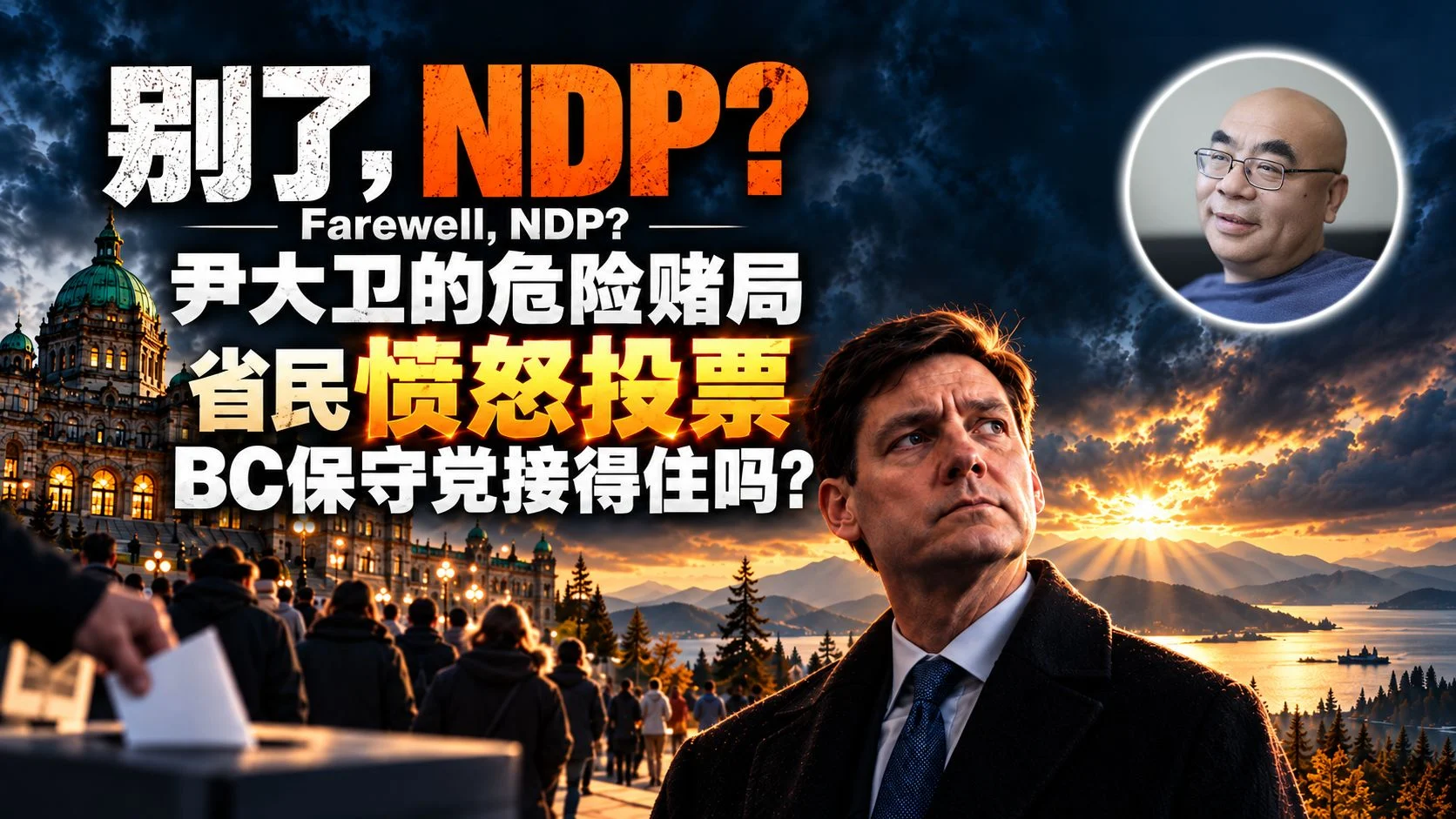
Farewell, NDP? Could an “Anger Vote” Reshape B.C. Politics?
British Columbia’s snap election campaign has barely begun, and the first major poll has already thrown cold water on David Eby.
The B.C. Conservatives are at 43 percent.
The NDP is at 35 percent.
Just around ten days earlier, the same polling organization had the NDP leading by four points.
Even more striking, 62 percent of British Columbians say the election was called too early. Only 21 percent believe the timing is right.
None of this tells us who will win on October 24.
Twenty percent of voters are still undecided, and only 35 percent say they are “very certain” about their current choice.
But the numbers raise an important question:
Could British Columbia be heading toward an “anger vote”?
By “anger vote,” I do not mean a term used by the pollster itself. I mean a political phenomenon in which a voter’s first motivation is not necessarily enthusiasm for the opposition, but a desire to punish the government already in power.
In the same poll, 54 percent said it is time for a change in government.
In other words, some ballots may first be votes against the government, and only secondarily votes for the alternative.
So why did David Eby choose to call an election now?
The NDP is not a minority government struggling to survive. It still holds a majority, and the next scheduled provincial election was not due until 2028.
Eby’s public explanation is that Donald Trump’s trade war and the economic pressure coming from the United States have created an “existential moment,” requiring a new mandate from British Columbians.
The pressure from the United States is real.
But the legislature was not paralyzed. The government had not lost a confidence vote. The NDP was still capable of governing.
So why was an election necessary two years early?
The political landscape at the time offers part of the answer.
The B.C. Conservatives had just gone through a serious internal crisis. Party leader Kerry-Lynne Findlay resigned. Members of the caucus had left. Lorne Doerkson had only just taken over as interim leader.
There was another timing issue that received far less attention.
B.C.’s municipal elections are scheduled for October 17.
The provincial election is October 24.
Just one week apart.
Municipal candidate nominations closed on September 11. The normal deadline to withdraw was September 18. The formal campaign period began September 19.
Eby called the provincial election on September 22.
That meant many local centre-right politicians who might otherwise have been potential provincial candidates were already running for mayor, council or school board.
Legally, withdrawing was not necessarily impossible.
Politically, it was much harder.
Campaign teams had already been assembled. Money had been spent. Supporters had been mobilized. Walking away in the middle of a municipal campaign to run provincially would carry a real political and reputational cost.
There is no evidence that Eby chose September 22 specifically to “lock up” potential Conservative candidates.
But the practical effect is difficult to ignore:
He chose a moment when the B.C. Conservatives would have had an unusually difficult time finding candidates at short notice.
Then something unexpected happened.
The snap election acted almost like a sudden call to assemble.
Seven MLAs who had joined another political formation quickly returned to the B.C. Conservatives. A party that had been fighting and fragmenting only days earlier suddenly began pulling itself back together.
Its candidate recruitment accelerated as well.
By the evening of September 29, roughly 72 named candidates could be counted on the B.C. Conservative website.
There are 93 ridings in the province, and nominations do not officially close until 1 p.m. on October 3.
The bigger question is therefore no longer whether the Conservatives can simply find enough names.
It is whether the candidates recruited in such a short period are strong enough.
Putting 93 names on ballots is one thing.
Building a team capable of running the Government of British Columbia is something else entirely.
That brings us to perhaps the most revealing contradiction in the entire election.
When voters were asked whether it was time for a change in government, 54 percent said yes.
But when they were asked whether the B.C. Conservatives were ready to govern, 56 percent said no.
Many British Columbians may already want to say goodbye to the NDP.
They simply have not yet found a way to do so that feels safe.
That may be David Eby’s biggest political protection at the moment.
Wanting a change of government and being willing to hand power to another party are not the same thing.
There is a threshold between the two.
The B.C. Conservatives therefore have to prove three things:
That they have people.
That they have policies.
And that they have the capacity to govern a province.
They have begun trying to answer those questions.
Doerkson has promised that a Conservative government would introduce no new taxes and would not raise existing tax rates.
The political message is clear.
But British Columbia is also facing a massive deficit.
So “no new taxes” answers only half the question.
What happens to spending?
How is the deficit reduced?
If revenues are not increased, which expenditures would be adjusted?
The Conservatives still need a much more complete fiscal answer.
They have also proposed a major expansion of liquefied natural gas production, faster project approvals and a more stable tax and royalty environment for the energy sector.
Eby, meanwhile, has been rolling out his own economic agenda.
His critical minerals plan calls for doubling B.C.’s production and exports of critical minerals within five years, speeding up mine approvals, expanding the North Coast Transmission Line, building more domestic refining and processing capacity, and increasing the capacity of the Port of Prince Rupert.
On resource development, the message is fairly aggressive:
Approve projects faster.
Build more infrastructure.
Produce more minerals.
Export more.
But when it comes to housing, Eby has chosen a very different set of tools.
On September 25, he proposed increasing B.C.’s speculation and vacancy tax and creating a new tax on unsold condominiums.
Under the proposal, a completed condo that remains vacant and unsold for more than a year would face a 2 percent tax in the second year, 3 percent in the third, and another percentage point for every additional year.
The NDP says there may be around 5,000 such units in Metro Vancouver, and argues that higher carrying costs could force developers to lower prices and bring those units onto the market.
The political language behind this approach sounds very familiar.
Ten years ago, when Greater Vancouver housing prices were rising rapidly, some of the most emotionally powerful terms in B.C. housing politics were:
Foreign buyers.
Chinese money.
Real-estate speculation.
Vacant homes.
At the time, David Eby was the NDP’s housing critic and one of the most active provincial politicians pushing the issue.
In 2015, Eby provided land-title data from a group of West Side Vancouver real-estate transactions to urban planner Andy Yan.
Yan later conducted a study that became highly controversial because one of the indicators used to infer buyers’ backgrounds was whether their names were “non-anglicized Chinese names.”
The debate over “Chinese buyers,” foreign money and housing prices quickly expanded, while many in the Chinese community argued that the discussion was turning into stigmatization.
In 2016, the NDP brought a real-estate speculation tax proposal into the legislature.
The B.C. Liberal government under Christy Clark initially resisted that approach.
Then, in July 2016, it abruptly changed course and introduced a 15 percent additional property transfer tax on foreign buyers in Metro Vancouver.
The design of that tax was not identical to the NDP’s earlier proposed 2 percent speculation tax.
But politically, something important had happened:
An issue the NDP had spent considerable time developing — that foreign capital and real-estate speculation required tax intervention — had effectively been taken over by the governing party.
In 2021, during hearings of B.C.’s public inquiry into money laundering, Eby was again questioned about the 2015 study and expressed regret over his involvement and the impact the controversy had had on the Chinese community.
Now, ten years later, many of the same political terms have returned:
Foreign speculators.
Vacant homes.
Property hoarding.
Unsold developer inventory.
But the housing market has changed.
According to the B.C. Real Estate Association, residential sales in August were 25.4 percent below the ten-year average for that month. The average sale price was also down 1 percent year over year, while active listings were approaching their highest levels since 2015.
Ten years ago, the questions were:
Why are so many people fighting to buy homes?
Why do prices keep going up?
Today, the questions are different:
Why are buyers staying away?
Why are completed condos not selling?
Why are prices still so high?
And perhaps most importantly:
Who will build the next round of housing?
That is the real question raised by the proposed tax on unsold condos.
One of Canada’s biggest housing-policy problems today is simply that not enough homes are being built.
According to the CMHC estimate cited in the video, Canada would need roughly 417,000 to 469,000 new homes a year through 2036 to restore housing affordability to 2019 levels.
At the current pace, the country is on track for only about 231,000 per year.
If a development is already sitting near the edge of financial viability, and unsold inventory would also face a progressively higher tax, could some developers simply decide not to start the next project?
There is no evidence yet showing exactly how many projects such a tax would cancel.
It could also succeed in forcing some existing inventory onto the market and lowering prices in the short term.
But housing policy cannot look only at today’s inventory.
Land supply, municipal development charges, financing costs, labour and material costs, and approval times are already major components of the cost of building.
If those pressures remain unresolved while a new tax is added at the very end of the development process, one question has to be asked:
Could forcing several thousand completed units onto the market today result in fewer homes being built tomorrow?
That brings us back to the election.
Fifty-four percent say they want a change of government.
Fifty-six percent say the B.C. Conservatives are not ready to govern.
Those numbers are not contradictory.
They describe the political anxiety at the heart of this election.
Many voters may be angry with the NDP.
But anger alone does not automatically change a government.
It needs somewhere to go.
If the B.C. Conservatives can use the remaining weeks to convince voters that they are organized, credible and capable of governing, the existing anti-government mood could become a powerful electoral force.
If they cannot, voters may reach the ballot box still angry with the NDP and ask themselves one final question:
Would the alternative actually be better?
David Eby was able to choose the moment when his opponents appeared most divided and least prepared.
What he cannot control is whether this snap election ultimately gives that same unprepared opposition the reason it needed to regroup — and become a government-in-waiting.
